Why Strong Financial Controls Are the Hidden Engine of Small Business Growth

A Strategic Analysis by Great White Financial Controls
For many small business owners, financial controls sound like something designed for large public companies and auditors. The reality is the opposite.
Strong financial controls are often the difference between businesses that scale profitably and those that struggle with cash flow, fraud risk, and unreliable financial information.
While entrepreneurs focus heavily on sales, marketing, and operations, the most durable companies build their growth on a foundation of disciplined financial systems.
Financial controls are not just about compliance or bookkeeping. They are about creating a reliable financial operating system that allows business owners to make better decisions, grow faster, and protect profitability.
What Are Financial Controls?
Financial controls are the policies, procedures, and systems used to ensure financial accuracy, protect assets, and prevent fraud or errors.
They typically include:
• Segregation of duties
• Cash reconciliation processes
• Vendor approval procedures
• Budget monitoring and variance analysis
• Financial reporting reviews
• Access control to accounting systems
The goal is simple: ensure that financial information is reliable enough to guide business decisions.
Without controls, the financial data guiding a company’s strategy can quickly become unreliable.
Why Financial Controls Matter More for Small Businesses
Small businesses face unique risks:
• Fewer employees performing multiple financial roles
• Limited accounting oversight
• Rapid operational changes
• Limited ability to absorb losses
Research consistently shows that small businesses experience disproportionately high losses from fraud and financial errors. A 2024 report from the Association of Certified Fraud Examiners found that the median loss from fraud in companies with fewer than 100 employees was $141,000 per incident.
For a business generating $2M in revenue with a 10% profit margin, that loss represents nearly an entire year of profits.
The Financial Impact of Good vs. Poor Controls
The difference between companies with strong controls and those without them becomes very clear when examining performance metrics.
Table 1
Firms With Strong Controls vs Weak Controls
| Metric | Strong Controls | Weak Controls |
|---|---|---|
| Financial reporting accuracy | High | Frequently inconsistent |
| Fraud risk | Low | High |
| Cash flow predictability | Stable | Volatile |
| Decision quality | Data-driven | Guesswork |
| Access to financing | Easier | Difficult |
| Profit margins | Higher | Eroded by inefficiency |
Strong financial controls also enable firms to respond faster to market changes and operate more efficiently.
Chart 1: Revenue Leakage from Weak Controls
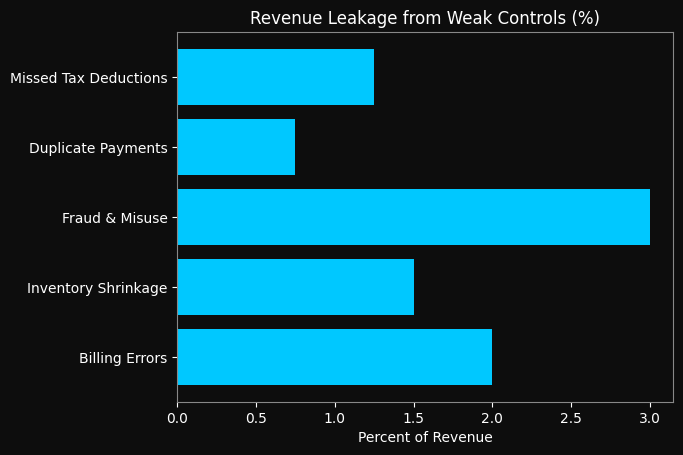
Example of how operational inefficiencies accumulate without controls.
| Source of Loss | Estimated Revenue Impact |
|---|---|
| Billing errors | 1–3% |
| Inventory shrinkage | 1–2% |
| Fraud and misuse | 1–5% |
| Duplicate payments | 0.5–1% |
| Missed tax deductions | 0.5–2% |
Total Potential Leakage
4–13% of revenue
For a $5M business, that can mean:
$200,000 – $650,000 in lost profit annually
Most owners never see these losses clearly because they occur gradually across multiple operational processes.
Case Study: Construction Firms and Internal Controls
A multi-company case study examining construction firms that implemented structured financial control processes found that businesses with improved internal control systems increased profitability and operational efficiency significantly compared with peers lacking structured controls.
The firms implemented:
• Job costing controls
• Vendor approval processes
• Expense authorization limits
• Financial statement review procedures
Within two years:
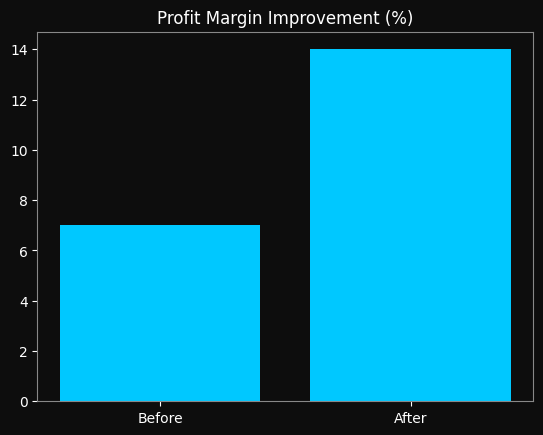
| Metric | Before Controls | After Controls |
|---|---|---|
| Profit margin | 7% | 14% |
| Cost overruns | Frequent | Rare |
| Cash flow forecasting | Inaccurate | Reliable |
| Bank financing access | Limited | Expanded |
The improvement came not from increasing sales but from eliminating operational waste and financial blind spots.
Chart 2: The Control Maturity Curve
Businesses typically move through four stages of financial maturity.
Stage 1 — Chaos
• No formal accounting system
• Owner tracks finances manually
• Cash flow surprises common
Stage 2 — Basic Accounting
• Bookkeeping system installed
• Monthly reports produced
• Limited oversight
Stage 3 — Financial Controls
• Segregation of duties
• Reconciliations and approvals
• Financial KPIs tracked
Stage 4 — Strategic Financial Management
• Data-driven decision making
• Forecasting and scenario analysis
• Strong investor and lender confidence
The jump from Stage 2 to Stage 3 is where many businesses double their profitability.
Chart 3: Operational Efficiency Improvements from Controls
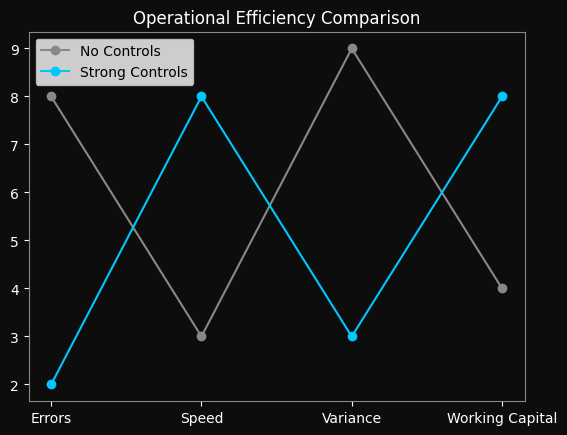
Research shows firms with internal control audits demonstrate higher operational efficiency than firms relying only on management reporting.
| Operational Metric | No Controls | Strong Controls |
|---|---|---|
| Vendor payment errors | High | Low |
| Reporting delays | Frequent | Rare |
| Budget variance | Wide | Controlled |
| Working capital efficiency | Poor | Optimized |
Real-World Example: Fraud Prevention
One of the most common internal control failures in small businesses is lack of separation of duties.
Example scenario:
Weak Controls
Employee responsibilities:
• Receives customer payments
• Records transactions in accounting software
• Performs bank reconciliation
This structure allows a single person to steal funds without detection.
Strong Controls
Responsibilities divided:
• Employee A receives payments
• Employee B records transactions
• Manager performs reconciliation review
The simple change dramatically reduces fraud risk because multiple people must now collude to bypass the system.
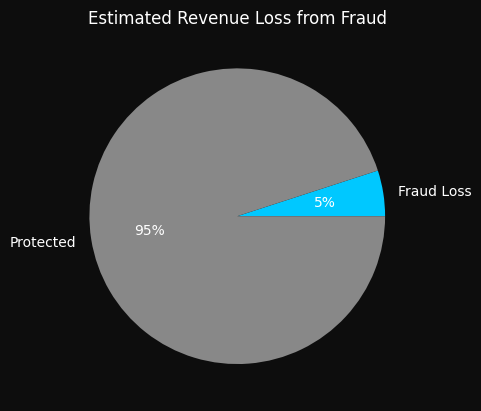
Organizations worldwide lose around 5% of revenue annually to fraud, much of it due to weak or nonexistent controls.
Financial Controls Also Improve Access to Capital
Banks, lenders, and investors look closely at financial reporting reliability.
Businesses with strong controls benefit from:
• Faster loan approvals
• Better financing terms
• Higher valuations in acquisitions
• Improved investor confidence
Private companies adopting public-company-style financial controls often find it easier to secure financing and scale operations.
The Profitability Multiplier Effect
Strong financial controls create a compounding benefit across the business.
Control → Insight → Action → Profit
Example:
Without controls:
• Inventory shrinkage goes unnoticed
• Profit margins slowly decline
With controls:
• Monthly inventory reconciliation detects the issue
• Vendor theft is identified
• Process is corrected
Profit margin increases immediately.
Multiply that effect across payroll, vendor payments, billing, and tax planning.
The Strategic Role of Financial Controls
Many business owners view financial controls as defensive.
In reality, they are a growth system.
Businesses with strong financial infrastructure gain three major advantages:
1. Faster Decision Making
Reliable financial data allows management to move quickly.
2. Operational Discipline
Processes become repeatable and scalable.
3. Investor-Grade Financial Reporting
Companies become more valuable and easier to finance.
The Great White Financial Controls Approach
At Great White Financial Controls, the goal is not simply bookkeeping.
The objective is to build a financial control architecture that allows businesses to scale with confidence.
Core areas include:
• Cash flow visibility
• Control design and implementation
• KPI reporting dashboards
• Budget and forecasting systems
• Fraud risk mitigation
• financial reporting discipline
For businesses in the $250K to $5M range, these systems often produce the fastest improvement in profitability available anywhere in the business.
Because before a company can grow efficiently, it must first know exactly what its numbers mean.
Final Takeaway
Sales drive revenue.
Operations deliver products.
But financial controls determine whether a business actually keeps its profits.
Companies that build disciplined financial systems early gain a structural advantage that compounds for years.
Those that do not often discover the hard way that growth without financial controls is simply risk at scale.
Book a free discovery call.
We’ll tell you exactly what your business needs — and what it doesn’t.