When Are Quarterly Taxes Due for Your Business?
When Are Quarterly Taxes Due for Your Business?
One of the most common and expensive surprises for business owners is discovering they were supposed to be paying taxes throughout the year, not just in April.
Quarterly estimated taxes catch many founders off guard, especially in their first few profitable years. Understanding when they apply, when they are due, and how to plan for them can save you from penalties, stress, and cash flow shocks.
What Are Quarterly Estimated Taxes?
Quarterly estimated taxes are payments made throughout the year on income that is not subject to automatic withholding.
If you are:
- Self-employed
- A business owner
- An independent contractor
- An S-corp owner receiving pass-through income
- A partner in a partnership
You are likely responsible for paying estimated taxes.
These payments cover:
- Federal income tax
- Self-employment tax (Social Security and Medicare)
- In some cases, state income taxes
Instead of one large tax bill, the IRS expects you to pay as you earn.
When Are Quarterly Taxes Due?
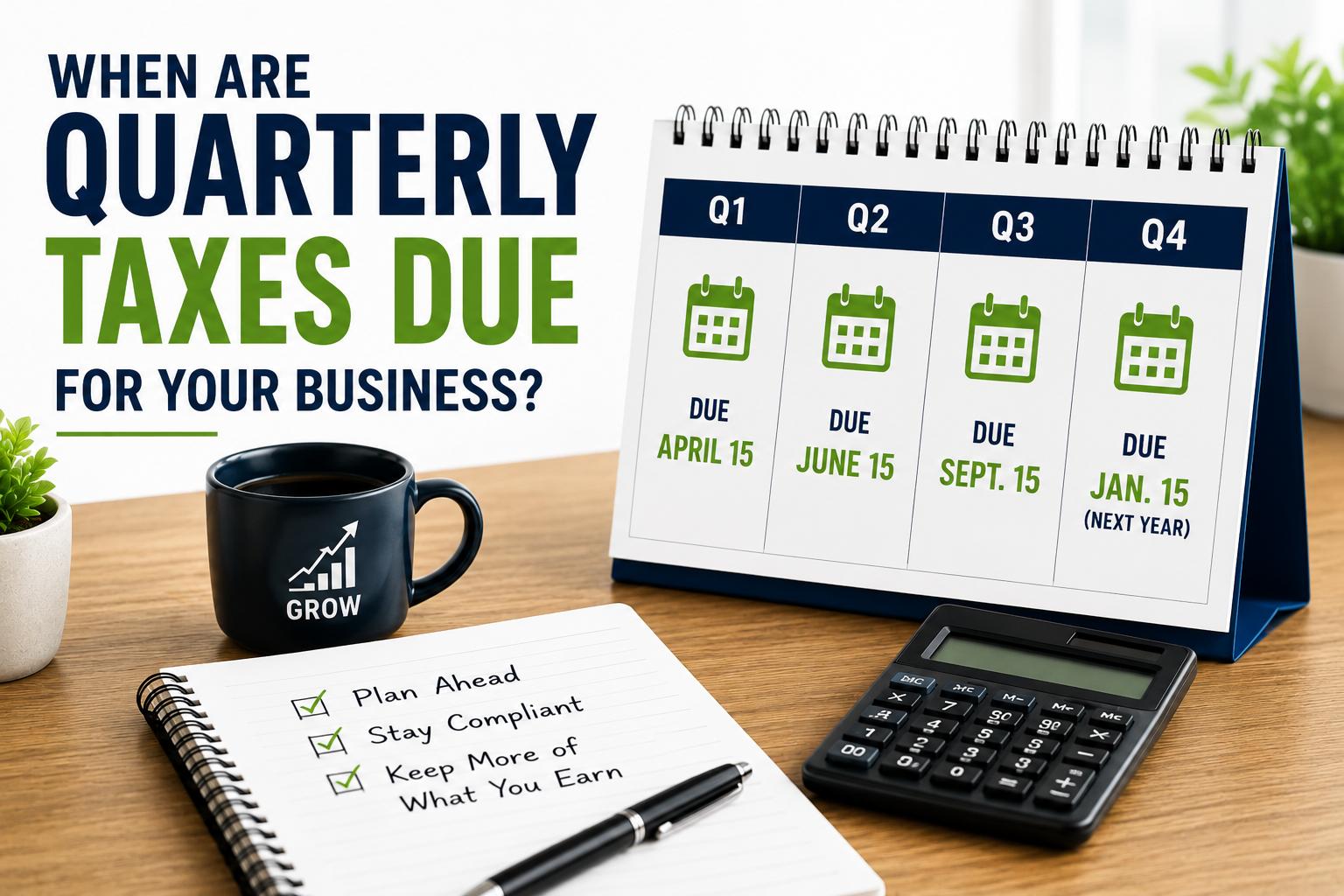
The IRS sets four estimated tax deadlines each year. They are not evenly spaced, which surprises many people.
Here are the standard due dates:
- April 15 for income earned January 1 through March 31
- June 15 for income earned April 1 through May 31
- September 15 for income earned June 1 through August 31
- January 15 of the following year for income earned September 1 through December 31
If a due date falls on a weekend or holiday, the deadline typically moves to the next business day.
Missing these deadlines can result in penalties, even if you pay your full tax bill by April.
Who Is Required to Pay Quarterly Taxes?
In general, you must make estimated payments if you expect to owe at least $1,000 in federal tax after subtracting withholdings and credits.
This often applies to:
- Sole proprietors
- Single-member LLCs
- Partners in partnerships
- S-corp owners with insufficient payroll withholding
Many business owners assume that forming an LLC automatically changes their tax obligations. In reality, it is how the business is taxed, not the legal structure alone, that determines quarterly payment requirements.
How Much Should You Pay Each Quarter?
There are two common methods.
Safe harbor method
You pay based on last year’s tax liability. This method reduces the risk of penalties, even if your income increases.
Current income method
You estimate your actual income for the year and divide payments accordingly. This requires accurate bookkeeping and forecasting.
The right approach depends on income stability, growth rate, and cash flow. Guessing often leads to overpaying or underpaying.
Why Bookkeeping Matters for Quarterly Taxes
Quarterly taxes are not just a tax issue. They are a systems issue.
Without up-to-date books, it is nearly impossible to:
- Estimate income accurately
- Set aside the right amount of cash
- Avoid scrambling before deadlines
- Prevent penalties and interest
Strong bookkeeping allows business owners to treat taxes as a planned expense, not an emergency.
What Happens If You Miss a Payment?
Missing or underpaying quarterly taxes can trigger:
- IRS penalties
- Interest charges
- Compounding balances
- Increased stress during tax season
The IRS does not require malicious intent to assess penalties. Simply being late is enough.
Planning Ahead Makes Quarterly Taxes Predictable
Quarterly taxes feel overwhelming when they are reactive. They become manageable when they are part of a financial system.
That system includes:
- Consistent bookkeeping
- Cash flow tracking
- Regular financial reviews
- Coordination between bookkeepers and tax professionals
With the right structure, tax payments stop being a surprise and start being just another scheduled obligation.
The Bottom Line
If your business earns income without withholding, quarterly taxes are not optional.
Knowing when they are due and how much to pay protects your cash flow, reduces penalties, and gives you peace of mind. More importantly, it puts you back in control of your finances instead of reacting to deadlines.
At Great White Financial, we help business owners build financial systems that make taxes predictable instead of painful. When your numbers are clear, your decisions become easier.
Book a free discovery call.
We’ll tell you exactly what your business needs — and what it doesn’t.